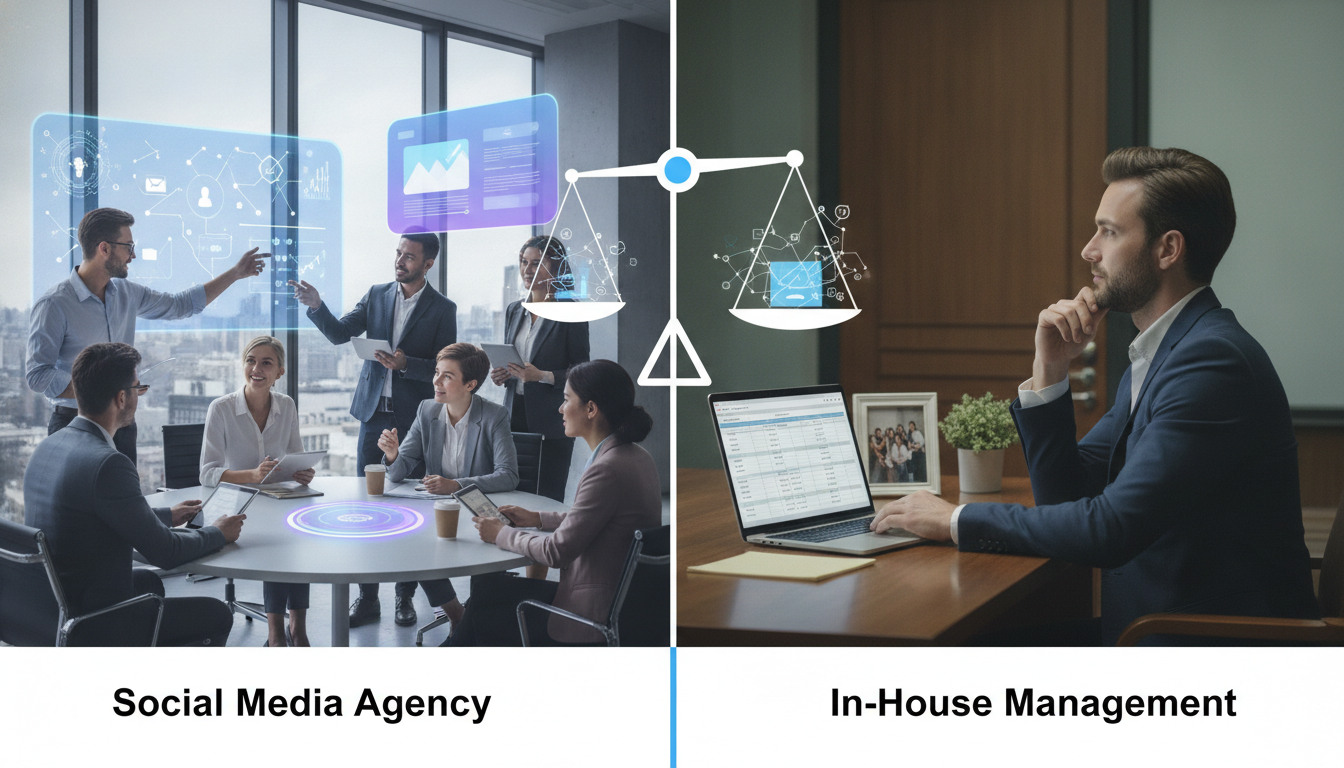
Social Media Agency vs In-House for Professional Services
Understanding the Core Issues Beyond Choice
In professional service firms, social media missteps aren't typically due to choosing between a social media agency vs in-house for professional services. The real disruptors are misaligned strategies and unclear objectives. When firms engage agencies without firm expectations or when internal teams lack strategic guidance, social media initiatives falter. Often, the focus drifts to just creating content when what's truly needed is strategic engagement that aligns with the brand.
The essence of effective social media management lies within clear role definition and strategic vision. Without a roadmap that mirrors business objectives, even top-tier social media agency or adept in-house teams may falter. Consider a law firm aiming to build thought leadership credentials. They must go beyond generic posts, developing content that showcases their expertise and nurtures client trust. This entails stakeholder collaboration early on, establishing shared goals, and valuing each team’s strengths within the broader business ecosystem.
Deciphering the Common Causes of Strategic Drift
Evaluating management choices begins with identifying deeper causes of misalignment—often disregarded realities, including:
- Strategic Ambiguity: Firms often kick off social media campaigns without clear objectives, leading to efforts that miss the mark. For instance, if a firm's campaign aims at enhancing engagement without precise success measures, these endeavors might not align with wider marketing benchmarks.
- Unclear Role Distribution: Undefined roles create ambiguity over content stewardship, brand voice, and response protocols, leading to inefficiencies and conflicts. Situations where both agency and internal teams assume client query responsibilities illustrate potential chaos, often resulting in communication delays.
- Misdirected Resource Allocation: Whether you're using a social media agency or in-house team, resources can sometimes get caught up in chasing trends instead of sticking to what works. Investing heavily in a platform like TikTok without evaluating its audience relevance can divert focus from better match channels.
- Lack of Impact Measurement: Not setting engagement, reach, and conversion benchmarks from the start makes it tough to adjust strategies effectively. Failure to establish these metrics upfront compromises strategic assessment and adjustments.
- Disconnection from Business Aims: Social media strategies often drift from core business goals, reducing their effectiveness. A firm set on improving client retention might miss the mark if its content persistently targets new client acquisition instead.
Quantifying Economic Risks from Strategy Missteps
Assessing the financial toll of misaligned social media strategies involves analyzing potential economic exposures. Key factors to consider:
- Opportunity Costs: It's about checking if time spent on the wrong content could be better used to improve client interactions or upsell professional services. This requires evaluating hours spent on unsuitable content rather than enhancing client service interactions or upselling qualified services.
- Brand Degradation: Inconsistent messages can confuse potential clients, causing your brand to suffer. A consultancy frequently shifting focus among industries without clear targets might bewilder clients about its core offerings.
- Client Turnover: Failure to interact meaningfully through social media can result in dwindling clientele. When engagement lapses occur, competitors often fill the void, effectively capturing attention.
- Fixed Expenditures: Salaries or agency fees persist regardless of outcomes, compounding fiscal impact when unnoticed inefficiencies go unchecked.
Consider a modeling example:
Exposure Cost = (Monthly Social Media Budget × Inefficiency Rate) + (Average Client Value × Loss Rate) + Brand Recovery Cost.
For example, a $10,000 monthly allocation with a 20% inefficiency and losing 5 clients monthly valued at $5,000 each, plus $3,000 in brand recovery costs, would lead to significant exposure costs.
This translates to $2,000 monthly in inefficiencies, $25,000 in churn losses, and $3,000 additional for brand recovery, totaling $30,000 in potential value lost, which could be redirected toward other key operational areas.
Mechanics Behind Agency versus In-House Dynamics
When determining strategy, focus on efficiency and effectiveness influencers:
- Agility versus Control: Internal teams offer enhanced control but may lack the agility found in agencies. An in-house team might address crises swiftly due to a deep company ethos understanding, whereas agencies pivot quickly in response to market evolutions, thanks to cross-industry insights.
- Scalability: Agencies adapt services promptly, while internal teams could face scalability limits. Agencies bring broader tools and personnel to handle expansions compared to the incremental pace of internal teams developing new competencies.
- Cost Considerations: Agencies typically present variable cost models, whereas internal costs are fixed, impacting budget flexibility. Agencies’ fees may align with performance or scope adjustments, offering flexibility with changing focus.
- Specialized Knowledge: Agencies offer expansive expertise across platforms, difficult for internal teams to match. Agencies stay on top of trends and emerging platforms, ensuring client strategies stay relevant.
- Core Business Focus: Outsourcing enables focus on core activities. This becomes crucial when internal talent is central to other strategic projects directly impacting client deliverables.
Evaluating the Trade-offs in Resource Allocation
| Aspect | Agency | In-House |
|---|---|---|
| Agility | High | Low |
| Control | Medium | High |
| Scalability | High | Medium |
| Cost | Variable | Fixed |
| Expertise | Wide | Narrow |
| Focus on Core Activities | Increases | Decreases |
Identifying Failures in Social Media Management Tactics
Clear pitfalls exist in both agency-run or internally managed social media initiatives. Common issues include:
- Misaligned Goals: Efforts are squandered when social media targets don't align with company objectives. A company seeking greater engagement yet focusing on likes rather than actionable policy inquiries loses potential impact.
- Underplanned Resource Allocation: In-house teams may not possess the time or expertise for strategic oversight. Stretching thinly across multiple roles can result in surface-level engagements over depth-focused campaigns demanding analytical insights.
- Communication Failures: Agency-client disconnects derail campaign effectiveness. Misalignment on campaign strategies between agency strategists and internal teams causes drift from firm goals, especially noticeable during product launches or urgent crisis handling.
- Resistance to Change: Internal teams may resist new tools or strategies. This often occurs in firms with long-standing teams hesitant toward novel engagement approaches like interactive content strategies.
Consider an internal management shift: One firm saw performance drop over 15% initially due to unclear strategies and role confusion, leading to necessary consultant involvement for skills and process alignment.
Setting Up a Firm Decision Framework
Effective strategic management requires aligning decision-making, risk-sharing, and enforcement:
- Rights in Decision-Making: C-level executives should handle strategic decisions, while operational teams make daily process decisions. Implementing a delegation matrix delineates responsibilities, decreasing overlaps and ensuring prompt handling of daily management tasks.
- Risk Distribution: Financial and reputational risk sharing must be transparent between executive sponsors and operational teams. Joint agreements on risk parameters afford clarity in role responsibilities, especially when campaigns deviate from expected outcomes.
- Accountability and Enforcement: Establish KPIs and hold responsible parties accountable to them. Routine evaluations and exploratory sessions ensure performance aligns with targets, promoting a data-driven accountability culture.
Ownership definitions are essential: make sure you have folks handling strategic oversight, tracking KPIs, and keeping the brand consistent. Regular realignment sessions ensure strategies adapt to market shifts or new business goals.
Strategic Positioning: The Real Competitive Edge
Choosing between a social media agency vs in-house for professional services redefines business dynamics. Agencies offer broad skill sets but could dilute control. Conversely, internal operations enhance control but risk straining resources. Ultimately, strategic choices shape use: aligning social media management with main business tactics and clearly defining operational frameworks fosters a competitive advantage. Firms aligning these dynamics effectively remain agile, able to pivot as required by market demands, whether by tactically seizing opportunities or addressing digital risks.
Key Takeaways
- Success in social media hinges on strategic alignment, not agency vs. in-house preference.
- Common pitfalls include misalignment and inefficient resource allocation.
- Quantifying economic exposure clarifies misalignment impact.
- Agility, control, and specialization trade-offs inform decisions.
- Effective management frameworks ensure accountability and mitigate failures.
Benchmarks and ranges serve as general industry guidelines. Actual outcomes will vary based on operation size, market specifics, and provider capabilities. Always validate metrics within your business context.
Frequently Asked Questions
How do I determine if a social media agency fits my needs?
Examine your strategic priorities, available resources, and need for specialized expertise. Agencies may be preferable for scalability and broad skill access. Assess whether your internal team can swiftly adapt to digital shifts or if an agency’s perspective offers more comprehensive results.
What's a typical mistake in managing social media internally?
Resource misallocation due to underestimating time and skills needed often leads to inadequate social media campaigns. This usually appears when staff juggle social duties with primary job roles, resulting in scattered focus and compromised quality.
How do management structures influence social media success?
Operational structures connect decision-making with strategic goals, enforcing accountability and adherence. These frameworks clarify roles, set reliable issue pathways, reduce risks, and enhance transparency and efficiency.
Can we transition from a social media agency vs in-house for professional services without disruption?
A smooth shift requires thorough planning, communication, and preparation for knowledge transfer to prevent performance dips. Adopting comprehensive change management strategies ensures smooth transitions and service continuity.
What social media success KPIs should we measure?
Essential KPIs include engagement, conversion, audience growth, and content reach, aligned with business goals. Regular KPI analysis informs strategic adjustments, ensuring alignment with broader objectives.