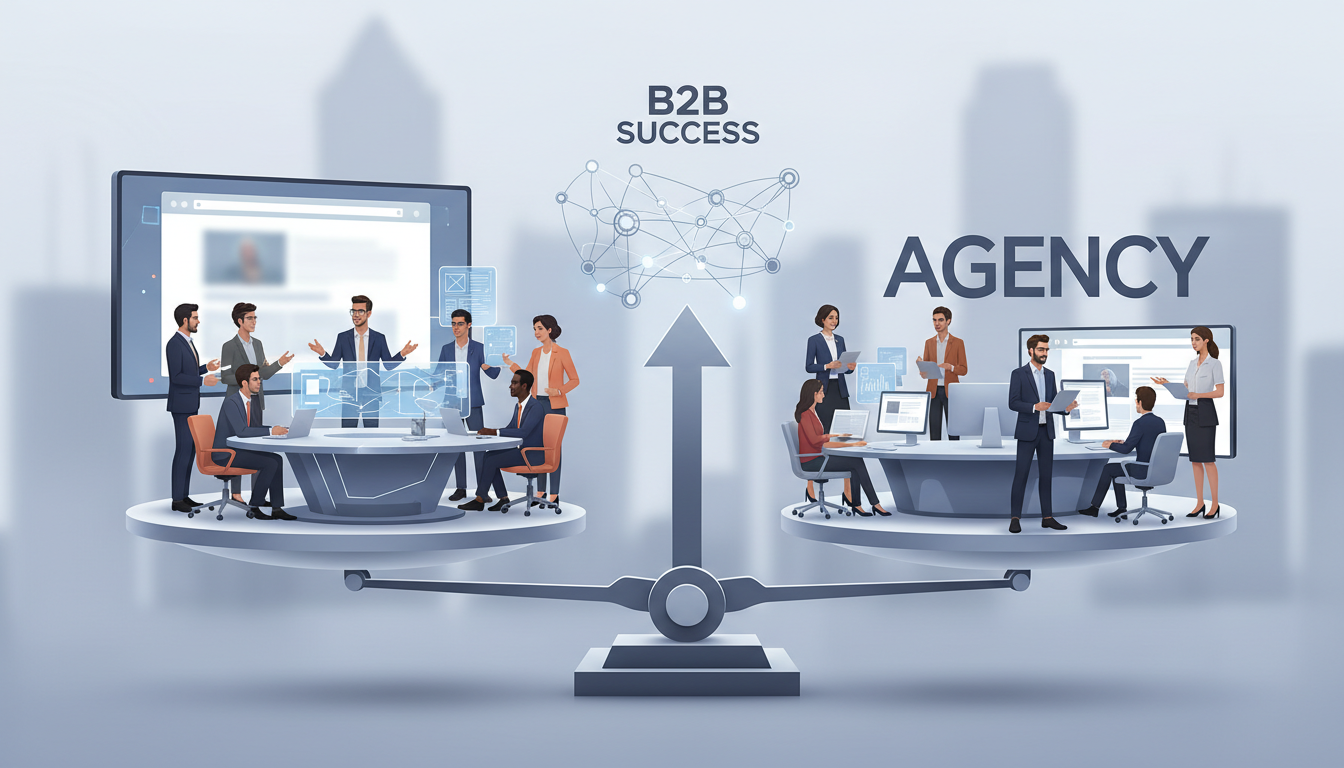
Website Design Agency vs In-House for B2B: Key Decisions
Core Reasons Behind B2B Website Design Failures
B2B website projects often falter due to issues beyond tools or creative vision. Companies often focus on selecting the right tool or design team, assuming this will solve underlying issues, but ignore strategic alignment. This mindset contributes to process and accountability failures, ultimately compromising project effectiveness. The key is identifying your internal capabilities, assigning decision rights correctly, and systematically managing risks. Without this framework, misaligned expectations and wasted resources are inevitable. For example, misalignment often results in fragmented client experiences, where critical functionalities do not integrate with the CRM, leading to inefficiencies in follow-ups and client engagement.
Identifying the Causes of Design Failures
Failures often arise from process missteps, not from technical inadequacies or creativity shortfalls. A disconnect between strategic goals and functional objectives typically undermines projects. Clarity on purpose ensures direction isn't lost. Poor management practices lead to unclear decision rights, causing delays. Stakeholder misalignment further derails projects; input from various departments such as marketing, sales, and IT is essential to form a unified vision. Without this, success metrics like conversion rates or lead generation goals are missed. Lastly, inadequate change management can create resistance to new systems, a significant barrier to project success.
The Economic Exposure of Design Decisions
Misaligned website design decisions significantly impact financial projections in the short and long term. Consider this formula:
Cost of Misalignment = (Internal Resource Hours × Hourly Rate) + (Opportunity Cost of Delay × Delay Duration) + (Client Dissatisfaction Impact × Lifetime Client Value)Take, for example, a project where 200 internal hours at $80 per hour yield a $16,000 error due to misalignment. Factor in a six-month delay on a $500,000 pipeline, risking an additional $41,000 in lost revenue. If client satisfaction dips by 5%, potentially losing a $100,000 lifetime client, the risk exposure totals $157,000. Therefore, understanding these costs is crucial to making informed decisions that align with financial goals.
Driving Success Through Specific Mechanisms
Possessing a thorough understanding of mechanisms is essential for achieving B2B success. Agencies can streamline creative processes, offering expertise in the latest design trends which can be critical in sectors where visual appeal directly impacts credibility and perceived value. However, these benefits come with upfront costs and dependency risks. Agencies excel at creative output due to established workflows but may lack insight into your specific business processes, introducing blind spots that could impact operational efficiency. Alternatively, in-house teams align well with internal processes. They are closely aligned with the organization's strategic aims, although this often leads to slower timelines and requires ongoing investment in talent acquisition and tool refinement. Internal teams face potential stagnation from balancing multiple responsibilities, which can dilute focus and reduce innovative thinking.
Evaluating Trade-offs Between In-House and Agency Models
| Factor | In-House Team | Design Agency |
|---|---|---|
| Integration | High internal alignment but slower innovation | Fast external execution but possible misalignment |
| Cost | Long-term development cost | High upfront cost |
| Flexibility | Limited by existing commitments | Varied expertise and capacity on demand |
| Ownership | Full but may limit creativity | Shared, leading to potentially innovative solutions |
These trade-offs often demand careful consideration of strategic needs versus operational capabilities. For example, a tech company may prioritize in-house teams for the close integration of technical needs, while a brand entering a rapidly evolving market might opt for an agency to engage on an emotional level quickly. Such decisions can significantly impact timelines, with agencies generally able to deliver completed projects 30% faster than in-house teams when evaluating "website design agency vs in-house for B2B."
Understanding Where Strategies Typically Falter
Grasping failure modes is critical. In-house teams can suffer from insular thinking, with limited exposure to new ideas, leading to creativity stagnation. Internal politics or budget restrictions can further constrain innovation. Design agencies risk failure if not integrated into broader strategies, resulting in polished outputs that don’t drive business objectives. Agencies may focus on visual appeal without converting, thus it is essential to ensure that aligning strategy with business goals remains a priority.
Building a Strong Operational Structure for Success
Success necessitates a strong operational structure. This involves establishing clear decision rights and risk allocations. Marketing should manage brand messaging, IT should oversee technical integrations, and sales should map lead-conversion paths. Risk allocation must align with strategic priorities. Change approvals shouldn’t rest solely on technical leads but include key stakeholders to maintain strategic alignment. Regular cross-departmental sessions and workshops can foster a culture of collaboration and shared goals, mitigating risks of communication breakdowns and ensuring the success of "website design agency vs in-house for B2B" decisions.
Strategic Positioning: Dynamics of use
The choice between agency and in-house steers internal power dynamics. Agencies offer external use with creative insights and access to advanced tools and methodologies that may elevate the market position rapidly. In-house teams yield deeper strategic integration, promoting coherence with ongoing projects but struggle with adaptability. Ultimately, it’s about where you place power: external creative use versus internal strategic control. The right choice involves leveraging each option's strengths in line with organizational goals. This dynamic forces companies to meticulously assess their strategic goals, team capabilities, and client expectations before committing to a specific model.
Key Takeaways
- Website design failures often come down to alignment issues, not technical skills.
- Success hinges on clear strategic goals, effective stakeholder coordination, and strong operations.
- Focus on decision rights and risk allocations beyond mere budget considerations.
- Balance between agency speed and in-house alignment for optimal results.
- Operational excellence ensures alignment with objectives and competitive advantage.
- Understand organizational dynamics to make informed strategic decisions.
Benchmarks and ranges are directional, based on industry patterns. Actual results vary by operation size, market conditions, volume, and provider capabilities. Validate all metrics with your specific providers and operational context.
Frequently Asked Questions
What benefits do design agencies offer?
Design agencies offer specialized skills, swift execution, and a fresh perspective, contributing to high-quality, quick outcomes. They bring diverse industry insights that can often challenge assumptions, fostering innovative design solutions that differentiate businesses in competitive marketplaces.
When should you consider an in-house team?
An in-house team is valuable for its deep integration with strategic goals, beneficial for projects needing continuous collaboration and agile adjustments to market or internal strategy shifts. They offer more control and consistency aligned with the company ethos and have the benefit of continual knowledge retention.
How to ensure agency outputs align with business goals?
Implement clear structures defining decision rights and alignment. Regular check-ins and metrics-focused reviews help ensure alignment. Establishing strong briefing processes and ongoing performance metrics is crucial, with a focus on measurable outcomes that align with pre-defined business objectives.
What are common failures in website design projects?
Failures often result from strategic misalignment, unclear objectives, and poor stakeholder coordination. Clear roles and metrics are key. Involving cross-functional teams in planning stages can preempt misdirection and reinforce project focus, reducing time spent on revisions and alignment issues.
How do you measure website design success?
Use KPIs like user engagement, conversion rates, and strategic alignment. Regular audits and stakeholder feedback gauge outcomes effectively. Comparing desired engagement patterns with actual user interactions provides insights that can guide iterative improvements and investment priorities.
